

July 15, 2026
Why storage conditions matter for research-grade peptides
An overview of how storage conditions, handling practices, and temperature control can influence peptide stability in research settings.
Research-grade peptides require careful handling. From sourcing to storage, each step can influence how a compound maintains its stability and analytical integrity over time.
Because peptides are sensitive molecules, laboratories often review storage conditions before incorporating them into research workflows. Temperature, exposure to moisture, reconstitution practices, and repeated handling can all affect consistency.
Peptides and stability
Peptides can be affected by environmental conditions. Heat, light, moisture, and contamination risk may all contribute to degradation or reduced stability.
For this reason, storage recommendations are not just logistical details. They are part of the overall research handling process.
When a compound is stored incorrectly, it may become harder to interpret results with confidence. A change in stability can introduce variables that were not part of the original research design.
Temperature control
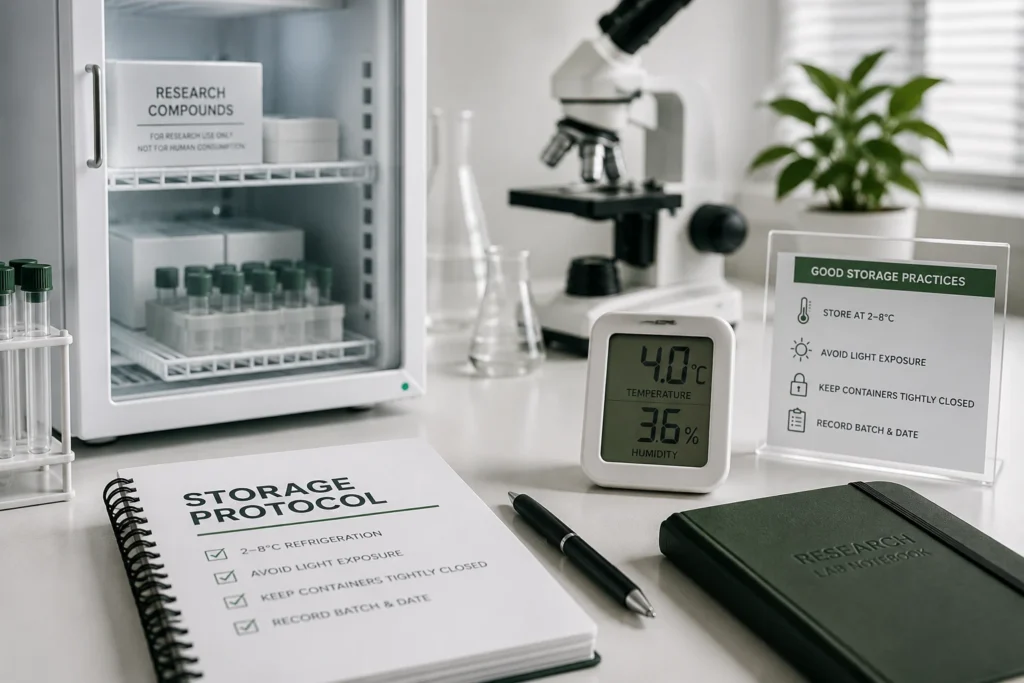
Temperature is one of the most important storage factors for peptide-based compounds. Many research peptides are stored under controlled cold conditions before use.
Exact storage requirements may vary depending on the compound, formulation, and supplier documentation. Laboratories should always review the storage instructions associated with each batch and follow internal handling protocols.
Temperature fluctuations should also be minimized whenever possible, especially during long-term storage.
Moisture and reconstitution
Moisture exposure can affect peptide integrity. Lyophilized materials are often handled carefully to reduce unnecessary exposure before reconstitution.
Once reconstituted, storage conditions may change. Researchers should review whether the compound has a different stability profile after being mixed with a diluent.
Clear labeling, controlled handling, and proper storage logs can help reduce confusion during research workflows.
Why handling records matter
Good research practice often includes keeping records of storage and handling. These records may include:
- Date received
- Batch number
- Storage temperature
- Reconstitution date
- Diluent used
- Handling notes
- Internal expiration or review date
These records help laboratories maintain consistency and traceability across experiments.
Reducing unnecessary variables
Research workflows are strongest when unnecessary variables are minimized. Proper storage and handling help reduce the chance that compound instability becomes a hidden factor in the research process.
By following documented storage recommendations and maintaining organized records, laboratories can better support consistency across protocols.
Final considerations
Storage conditions are a key part of peptide research preparation. While purity and COA documentation are important, handling and storage also play a major role in maintaining compound reliability.
For laboratories working with research-grade peptides, storage practices should be treated as part of the quality control process from the moment a compound is received.