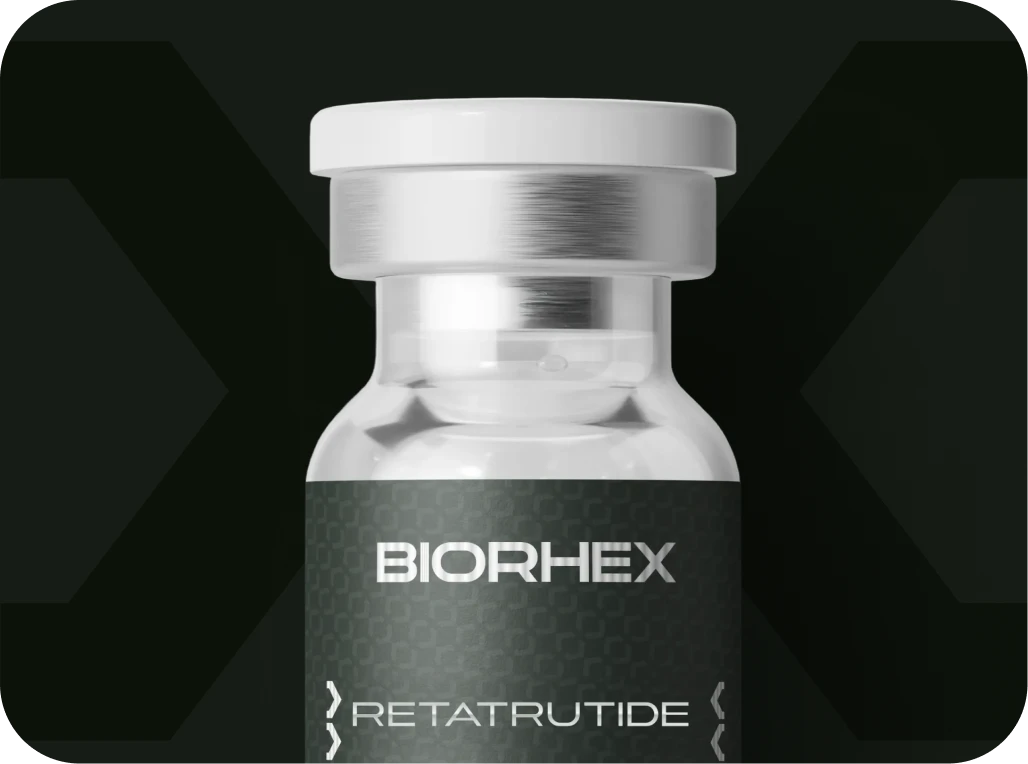
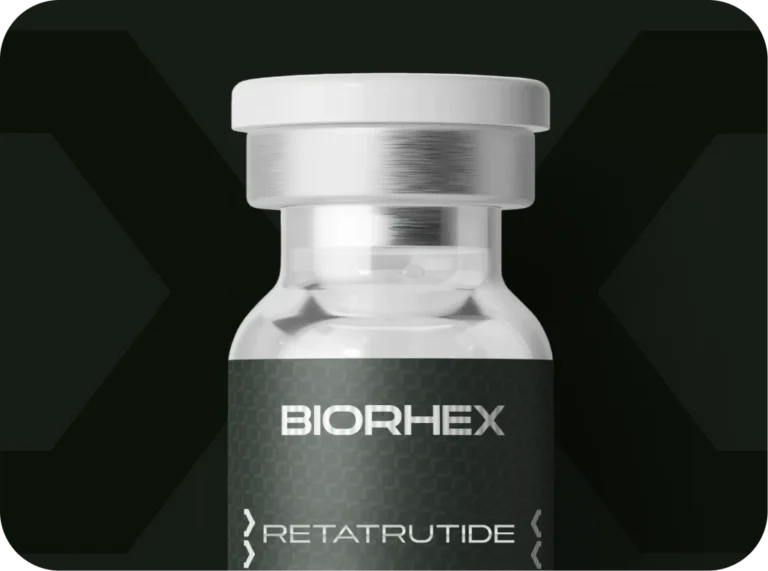
Retatrutide
$169.00 – $649.00Price range: $169.00 through $649.00
- In stock
- COA-verified
- ≥99% purity.
- USA manufactured.
- In stock
- COA-verified
- ≥99% purity.
- USA manufactured.
- COA-verified
- In stock
- ≥99% purity.
- USA manufactured.
- In stock
- ≥99% purity.
- USA manufactured.
- In stock
- ≥99% purity.
- USA manufactured.
- In stock
- ≥99% purity.
- USA manufactured.
What Is Retatrutide?
Retatrutide is a synthetic peptide designed as a triple agonist of the GIP receptor (GIPR), GLP-1 receptor (GLP-1R), and glucagon receptor (GCGR). In research settings, Retatrutide is studied for its simultaneous activation of three metabolic receptor pathways and the resulting complex signaling interactions across pancreatic, hepatic, hypothalamic, and adipose tissue models.
BioRhex supplies Retatrutide as a research compound manufactured in a GMP-compliant US facility, tested to ≥99% purity via HPLC and mass spectrometry, and supplied strictly for controlled laboratory research — not for human or animal use.
Compound Overview
Retatrutide is a triple incretin-glucagon receptor agonist studied for its multi-axis metabolic signaling. In vitro and preclinical research models examine how Retatrutide may influence:
• Simultaneous GIP-R, GLP-1R, and GCGR activation and downstream signaling dynamics
• Hepatic glucose production and lipid oxidation pathway interactions
• Hypothalamic energy regulation and appetite signaling pathway models
• Pancreatic beta and alpha cell function signaling
• Brown adipose tissue thermogenesis pathway modeling in preclinical systems
All findings referenced are from controlled research environments and do not represent clinical outcomes or therapeutic claims.
History of Retatrutide
Retatrutide was developed by Eli Lilly as an extension of dual incretin agonism research, incorporating glucagon receptor co-activation alongside GIP and GLP-1 receptor agonism. The design rationale was based on research suggesting GCGR activity could augment hepatic fat metabolism and thermogenic signaling.
The triple agonism approach creates a more complex pharmacological model for studying metabolic pathway interactions, as GCGR activation introduces additional hepatic and thermogenic signaling components not present in dual incretin models.
Retatrutide represents the current frontier of multi-receptor metabolic agonist pharmacology research.
Structure
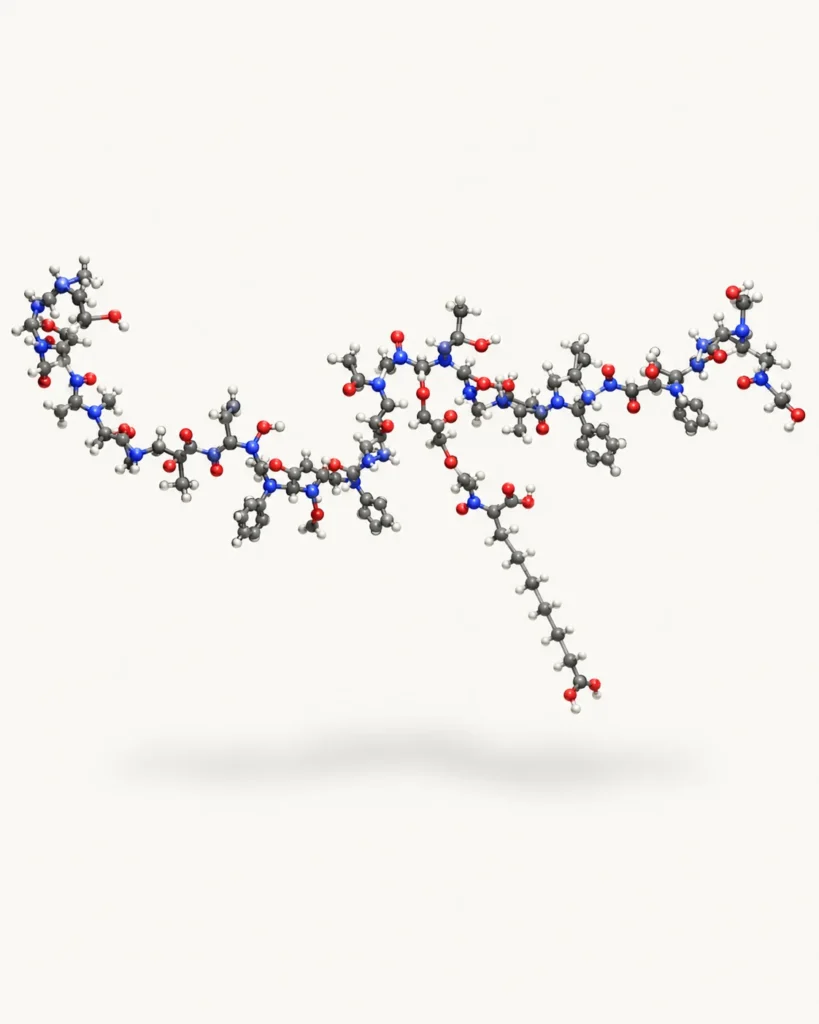
Reserch-grade coenzyme compound visualization.
COMPOUND
YXQGTFTSDYSILLDKKAQXAFIEYLLEGG PSSGAPPPS
TYPE
Triple GIP/GLP-1/glucagon receptor agonist
MOLECULAR FORMULA
C₂₂₁H₃₄₂N₄₆O₆₈
MOLECULAR WEIGHT
4731.34 g/mol
PURITY
≥99%
ANALYSIS
HPLC Verified
STORAGE
Store at -20°C. Protect from light and moisture.
CLASSIFICATION
Reserch Use Only
Research Findings
Published and preclinical research on Retatrutide covers several areas of scientific investigation, including:
Triple receptor agonism research: Studies examine Retatrutide’s comparative potency and selectivity at GIPR, GLP-1R, and GCGR in receptor expression systems.
Hepatic metabolism signaling: Research explores how glucagon receptor co-activation modulates hepatic glucose production and lipid oxidation pathway dynamics.
Hypothalamic signaling models: Laboratory studies investigate energy balance and appetite pathway interactions resulting from triple incretin axis activation.
Thermogenesis pathway research: Preclinical models examine glucagon receptor-mediated brown adipose tissue activation and its interaction with GLP-1R signaling.
All findings referenced are from controlled, non-clinical research models and do not imply therapeutic or clinical application.
References
1. Jastreboff AM, Kaplan LM, Frías JP, et al. (2023). Triple-Hormone-Receptor Agonist Retatrutide for Obesity — A Phase 2 Trial. New England Journal of Medicine, 389(6), 514–526. https://doi.org/10.1056/NEJMoa2301972
2. Rosenstock J, Frías JP, Jastreboff AM, et al. (2023). Retatrutide, a GIP, GLP-1 and glucagon receptor agonist, for people with type 2 diabetes: a randomised, double-blind, placebo and active-controlled, parallel-group, phase 2 trial. The Lancet, 402(10401), 529–544. https://doi.org/10.1016/S0140-6736(23)01053-X
3. Coskun T, Urva S, Roell WC, et al. (2022). LY3437943, a novel triple glucagon, GIP, and GLP-1 receptor agonist for glycemic control and weight loss. Cell Metabolism, 34(9), 1234–1247.e9. https://doi.org/10.1016/j.cmet.2022.07.013
4. Sanyal AJ, Kaplan LM, Frías JP, et al. (2024). Triple hormone receptor agonist retatrutide for metabolic dysfunction-associated steatotic liver disease. Nature Medicine, 30(7), 2037–2048. https://doi.org/10.1038/s41591-024-03018-2
FAQ
What type of research is Retatrutide used for?
Retatrutide is used in laboratory research settings. All supplied compounds are intended strictly for in vitro and preclinical research purposes. Use is limited to controlled scientific environments.
Where is BioRhex’s Retatrutide manufactured?
All BioRhex compounds, including Retatrutide, are manufactured in a GMP-compliant facility located in the United States.
What testing does BioRhex conduct on Retatrutide?
Every batch of Retatrutide undergoes third-party HPLC purity testing, mass spectrometry identity verification, and sterility testing. A Certificate of Analysis is included with every order, documenting batch-specific purity data at a ≥99% threshold.
Is Retatrutide approved for human use?
No. Retatrutide is not FDA-approved and is not intended for human or animal administration. It is supplied exclusively for laboratory research purposes.
Who should handle this compound?
Only qualified personnel in controlled laboratory settings following appropriate safety and handling protocols.
Research Use Only
All BioRhex compounds are supplied strictly for laboratory research purposes. Not for human or animal consumption, medical use, or therapeutic application. Retatrutide is not FDA-approved for any medical purpose. Nothing on this page should be interpreted as health guidance or applied outside controlled research settings.