
Cellular Energy Research Stack
$509.00
- In stock
- COA-verified
- ≥99% purity.
- USA manufactured.
- In stock
- COA-verified
- ≥99% purity.
- USA manufactured.
- COA-verified
- In stock
- ≥99% purity.
- USA manufactured.
- In stock
- ≥99% purity.
- USA manufactured.
- In stock
- ≥99% purity.
- USA manufactured.
- In stock
- ≥99% purity.
- USA manufactured.
What Is Cellular Energy Research Stack
A laboratory stack for investigating mitochondrial membrane function, cellular redox state, energy metabolism, oxidative-stress signaling, and mitochondria-to-nucleus communication.
METABOLIC RESEARCH STACK
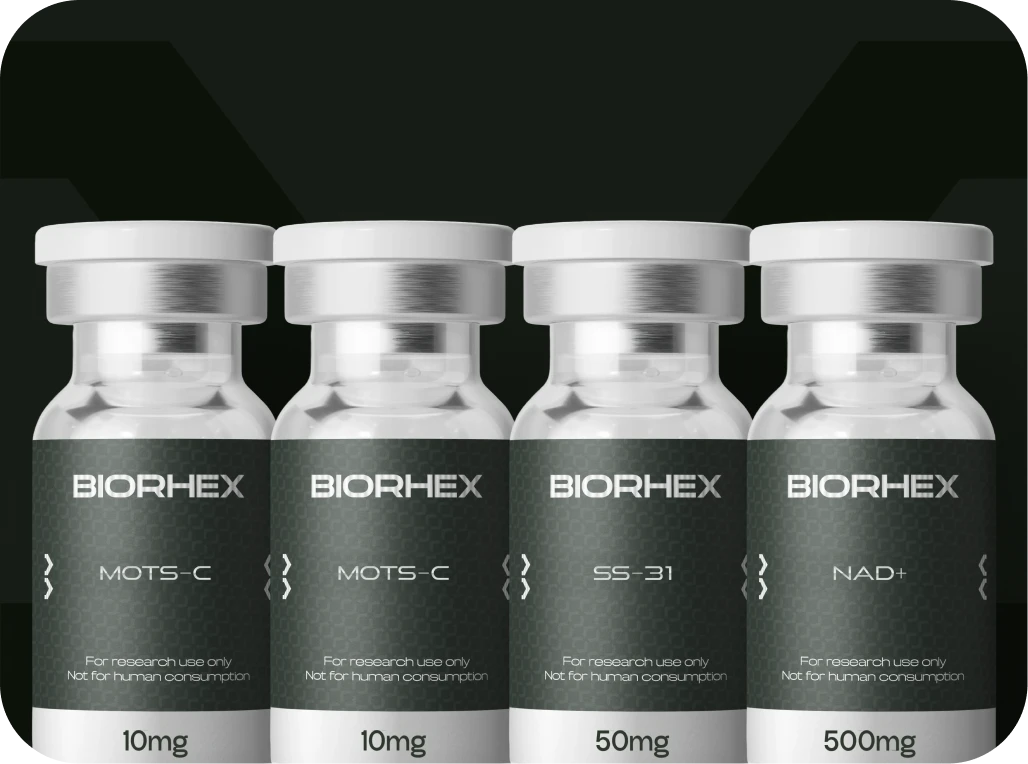
COMPONENT
SS-31
NAD+
MOTS-c
QUANTITY
50mg
500mg
10mg × 2
RESEARCH CLASS
mitochondria-targeting tetrapeptide research
dinucleotide coenzyme and redox research
mitochondrial-derived peptide research
Compound Overview
The Cellular Energy Research Stack brings together three compounds used in mitochondrial and bioenergetic research. SS-31, also known as elamipretide in clinical-development literature, is a mitochondria-targeting aromatic-cationic tetrapeptide studied for interactions with cardiolipin and mitochondrial membrane function. NAD+ is a central redox coenzyme involved in electron transfer, energy metabolism, sirtuin activity, and DNA-repair pathways. MOTS-c is a mitochondrial-derived peptide investigated as a signaling molecule linking metabolic stress to nuclear gene expression.
This stack contains chemically and biologically distinct components. Each compound should be handled and evaluated separately according to the research protocol.
Mitochondrial inner-membrane and cardiolipin interaction studies
NAD+/NADH redox-state and cellular energy pathway modeling
Reactive oxygen species and oxidative-stress response research
Mitochondria-to-nucleus communication and stress-induced gene expression
Skeletal-muscle, cardiac, and cellular bioenergetics models
BACKGROUND & HISTORY
SS-31 arose from Szeto-Schiller peptide research focused on mitochondrial targeting. NAD+ has been recognized for decades as a central cellular redox cofactor and later became a major subject of sirtuin and aging-biology research. MOTS-c was identified from a short open reading frame within mitochondrial 12S rRNA and helped establish the concept that mitochondrial DNA encodes signaling peptides in addition to respiratory-chain proteins.
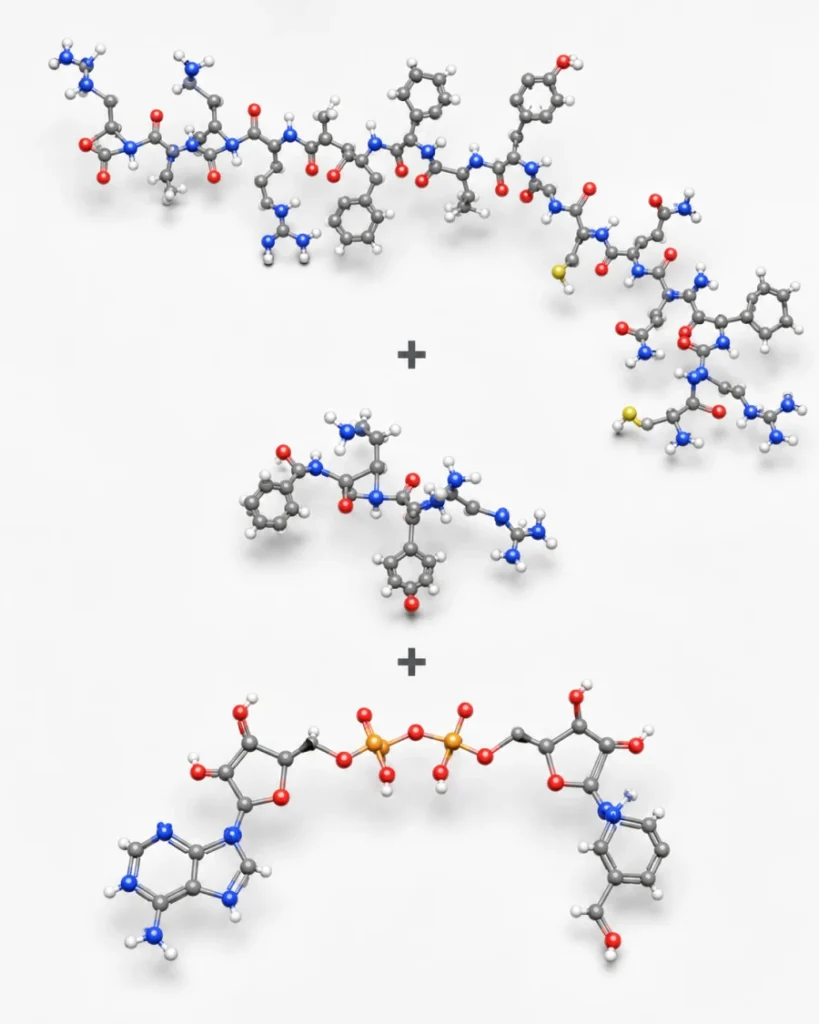
Structure
Reserch-grade coenzyme compound visualization.
COMPOUND
SS-31 + NAD+ + MOTS-c
TYPE
Multi-component mitochondrial and cellular energy research stack
MOLECULAR FORMULA
Not applicable (multi-component formulation)
MOLECULAR WEIGHT
Not applicable (individual component molecular weights vary)
PURITY
≥99%
ANALYSIS
HPLC Verified
STORAGE
Store at -20°C. Protect from light and moisture.
CLASSIFICATION
Reserch Use Only
Research Findings
Published and preclinical research relevant to the individual components covers several areas of scientific investigation, including:
SS-31 research: Studies investigate mitochondrial membrane stabilization, cardiolipin interactions, ATP-related function, and oxidative stress.
NAD+ biology: Research examines redox reactions, energy transfer, sirtuin signaling, PARP activity, and DNA-repair pathways.
MOTS-c signaling: Experimental work explores AMPK-associated pathways, metabolic stress adaptation, nuclear translocation, and gene regulation.
Combined research context: The components enable comparative analysis of membrane-level, coenzyme-level, and peptide-signaling mechanisms.
References
1. Szeto HH. (2014). First-in-class cardiolipin-protective compound as a therapeutic agent to restore mitochondrial bioenergetics. British Journal of Pharmacology, 171(8), 2029–2050. https://doi.org/10.1111/bph.12461
2. Whitson JA, et al. (2020). SS-31 and NMN: Two paths to improve metabolism and function in aged hearts. Aging Cell, 19(10), e13213. https://doi.org/10.1111/acel.13213
3. Verdin E. (2015). NAD+ in aging, metabolism, and neurodegeneration. Science, 350(6265), 1208–1213. https://doi.org/10.1126/science.aac4854
4. Lee C, et al. (2015). The mitochondrial-derived peptide MOTS-c promotes metabolic homeostasis and reduces obesity and insulin resistance. Cell Metabolism, 21(3), 443–454. https://doi.org/10.1016/j.cmet.2015.02.009
FAQ
What type of research is this stack used for?
Cellular Energy Research Stack is intended for controlled in vitro, analytical, and preclinical laboratory research involving the pathways described on this page. Experimental design should address each component independently.
Where is BioRhex’s Cellular Energy Research Stack manufactured?
All BioRhex compounds included in this stack are manufactured in a GMP-compliant facility located in the United States.
What testing does BioRhex conduct on the included compounds?
Each applicable batch undergoes third-party HPLC purity testing, mass spectrometry identity verification, and sterility testing. Batch-specific Certificates of Analysis are included or made available for the individual components.
Does the stack have one molecular formula or one Certificate of Analysis?
No. A stack contains multiple independent compounds. Each component has its own molecular identity, batch number, test results, and Certificate of Analysis.
Is this stack approved for human use?
No. The compounds in this stack are not supplied for human or animal administration. They are provided exclusively for laboratory research purposes.
Research Use Only
All BioRhex compounds in the Cellular Energy Research Stack are supplied strictly for laboratory research purposes. Not for human or animal consumption, medical use, diagnostic use, or therapeutic application. The compounds are not represented as FDA-approved for the uses described on this page. Nothing in this document should be interpreted as health guidance, dosage guidance, or a recommendation for use outside controlled research settings.